Mental Health: What Did and Did Not Work for Me
I had a very long struggle with depression that started in my early teen years. There were easy years and many really hard years. The specifics of why I was depressed and how I experienced depression are not things I want to share here. Instead, I’d like to share what did and did not work for me as I moved through it.
It’s worth noting here that your experience with some of these things may be really different, which is a great thing. And, while there were moments in my life when I did not believe this, the most important thing to remember is: it is possible to move through depression. I can tell you, great things are on the other side.
Therapy
My first experience with therapy was a court ordered therapist who specialized in criminal delinquency. It was a fantastic experience and one I really needed at 17-18. It’s not hyperbole to say that he changed the trajectory of my life: if I hadn’t started working with him, I would have only just gotten out of jail a few years ago.
As an adult, I’ve worked with 4 different therapists across a few different modalities. And, as an adult, I’ve largely found talk therapy to be ineffective. If it is effective, it is a very slow process. When I polled some of my friends about it, I generally found the same answer (though, of course, not always).
What gives?
The court ordered therapist I had as a teenager was very different from any other therapist I’ve worked with, interviewed, or heard about. I’ve actually never been able to find a therapist like him. He was a retired boxer and kind of a bully. He would interrupt me and say “that’s shite, Fleischmann!” (he was Scottish). It was great. Sometimes we walked around the garden of the reintegration school he ran. Sometimes we sat in big, fat leather chairs next to a fire place.
Most therapy is sitting and talking (face to face) and it prioritizes you continuing to come to therapy. Those are sometimes at the expense of making progress. Guys tend to gravitate to side by side activities: when guys get together, it’s to do something as a proxy for connecting. And, for most guys, the experience of connecting and sharing your experience isn’t meaningful enough on its own, without an activity, and without progress.
I’m not going to say you shouldn’t see a therapist - the opposite, in fact. I recommend trying it. Like I said, it changed the trajectory of my life. But, eyes wide open, good therapists are really hard to come by and I’m not sure the way most therapy is practiced is on net very effective for men. My teenage experience aside, for me, in my adult life, it was one of the least effective things I tried to process and move through my depression.
Men’s groups
Important definition here: groups of guys doing something where support is a feature but not the central focus of the group. I would lump group therapy in with regular therapy, but my experience there is a lot more limited. Instead, what I’m talking about here are groups of guys that are focused on doing something together and where supporting each other is a feature, but not the focus, of the group.
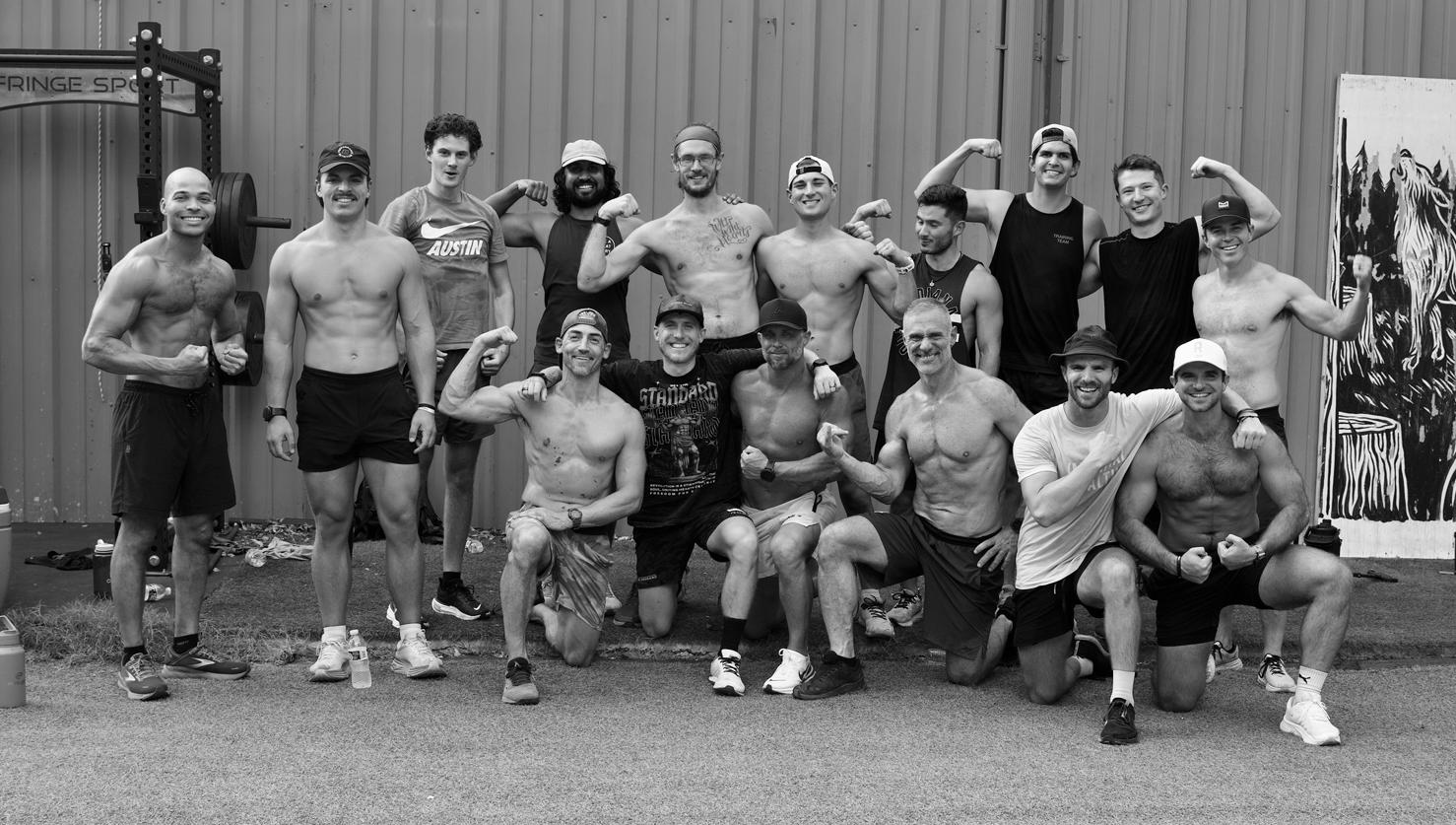
Men’s bible study groups have been one very effective version of this for me. And my gym hosts a group called Men in the Arena that organizes biweekly mens workouts.
The most effective formats of this (again, for me) have involved an element competition.
In all cases, the groups are (a) only men, (b) focused on an activity (studying the Bible, working out, playing cards), and (c) supporting each other is a feature of the group but not the group’s sole focus. It happens naturally and as necessary.
After a tough break up a few years ago, I joined a group of guys who were training for a fitness competition. The first workout we all did together, the coach had to cut me off. I hadn’t finished the workout and we needed to return the equipment to the gym. Meanwhile, all the other guys in the group had finished and were sitting around. I was by far the weakest, slowest dude in the group. Over 3 months of working out 2-3 times per week with these guys - and being guys in the process, joking around, teasing each other, etc - I was mostly out of the funk caused by the break up and I’d climbed my way up to being one of the faster guys in the group.
That worked so well for me. Climbing the ranks. Joking around with the boys. Competing against each other while also cheering each other on. Men’s groups were one of the most effective things I tried.
Antidepressants
Did not work for me. They really backfired. I had a terrible experience with antidepressants.
Guy’s night
Guy’s night gets a bad rap, but they’re so simple and they are really effective.
A study from the University of Oxford showed that men need a minimum of 2 guy’s nights per week to maintain normal levels of mental health - 2 nights, minimum.
I host guy’s nights and they’re fucking great.
How to organize a guy’s night:
- Text everyone a week or two in advance
- Guy’s night is bring your own protein
- Light the grill and fill a cooler with ice
- Buy some pre-made sides from the grocery store
Everyone is responsible for bringing their own protein and grilling it for themselves. Same with drinks. No breath work. No sharing circle. Just guys being guys.
Everyone loves these. And it really is the best of guys being guys. One of my friends recently became a dad for the first time and (naturally) we roasted him and joked around. And the other dads shared a lot of really great advice on becoming a father, navigating the changes in your marriage that come with having your first kid, and ways to support your breastfeeding and sleep deprived wife. They exchanged numbers and still share advice with each other.
Regular guys nights are great and have been really great for me.
A group chat with “the boys”
The group chat is sacred. Honor your boys. Your testosterone levels are directly and linearly correlated with the number of Hell yea’s you get from your group chat.
Accepting responsibility
This was a really tough one:
The things that lead me to be so depressed were often not my fault and very unfair. Some of them were patterns that I was stuck in and kept repeating. Many of them were defense mechanisms that had been effective at some point. Some of them were things that no one should have to go through.
And yet, I was the one who was depressed. It was my responsibility to get better. I owed that to myself. And no one else could give it to me anyway.
Older and younger male friends
There’s a lot of value in having male friends who are much older and male friends who are much younger. A good men’s group can provide this naturally, but I have found it helpful to seek it out too. I have a few friends who are older, including one who is 20 years older than me. And I have a few friends who are much younger, including some that are 10 years younger than me.
My pet theory is that age is a rough proxy for status and competence, which affect your testosterone levels in different, but positive ways. At any rate, older and younger friends provide a lot of perspective and meaning.
Being one of the youngest, least established, least competent guys in a group is good for you in a type-2 kind of way: it gives you good perspective on how much you still have to grow and learn. Older guys can share their experiences of going through something and it is the most effective way to learn that there is no real destination in life.
Similarly, being one of the oldest, most established, most competent guys in a group is good for you: it gives you perspective on how far you’ve come, how much you’ve learned, and how much you have to offer.
Long walks
One very effective thing I’ve done a few times over my adult life is go on a really, really long walk. No phone - or, if you do bring it, put it in airplane mode. No headphones. Wear good shoes. Bring a notebook and a pen and a water bottle. Then, just go out walking.
5-10 miles is a good micro dose. I recommend at least 20 miles.
Ambition, with perspective
This last one is a little tricky, but I think it can be summed up as a vision or intention for the arc of your life. Assume you’re going to live until you’re 80 years old. How do you want those decades to unfold? How do you want to experience them?
Loosely held intentions are better than specific goals here: I’ll spend my 20s, 30s, and 40s starting and building companies, shift my focus to writing in my 40s and 50s, and then spend my 60s and onward focused on volunteering and traveling. I want it to feel like an adventure and I want to be healthy and surrounded by community for as much of it as possible.
What is actually helpful about this is the perspective you can derive from keeping this arc in mind:
“I want my life to feel like an adventure.
An adventure story is only interesting if there’s tension, drama, and setbacks. Indianan Jones almost gets his heart pulled out of his chest by a death cult before he saves the day! So, okay - this is some tension. This is a setback. And luckily no one is trying to pull my heart out of my chest.
But this is the part of the story that makes the other parts before and (especially) after feel worthwhile.”
Holding the ambition (or intention) with the perspective has been very grounding for me.
You’re not alone
I’ll end with this:
The vast majority of Great Men throughout history went through a prolonged period of depression at least once in their life. Many of them are defined by the things they did or the men they became because of that depression. There is no unwavering resolve that the Union will stay together without Abraham Lincoln’s long struggle with melancholy. Teddy Roosevelt became the larger-than-life Colonel, Rough Rider, and statesman after losing his wife and mother in the same day and heading West to grieve. Winston Churchill became The Lion of Great Britain by taming the Black Dog first. Ernest Hemingway. Martin Luther King. Sylvester Stallone. Mark Twain. Beethoven. Darwin. Newton. Everyone. Everyone spent their 40 days in the desert. Everyone had to tame the black dog.
In the intro, I said the most important thing is: it is possible to move through depression. A close second is: you’re not alone.
Every time I opened up about my internal struggle, I was met with support and familiarity. Joking and teasing too, it’s an important part of male friendship. But everyone goes through this at some point and your boys want to help you.